
Gratuity Calculator
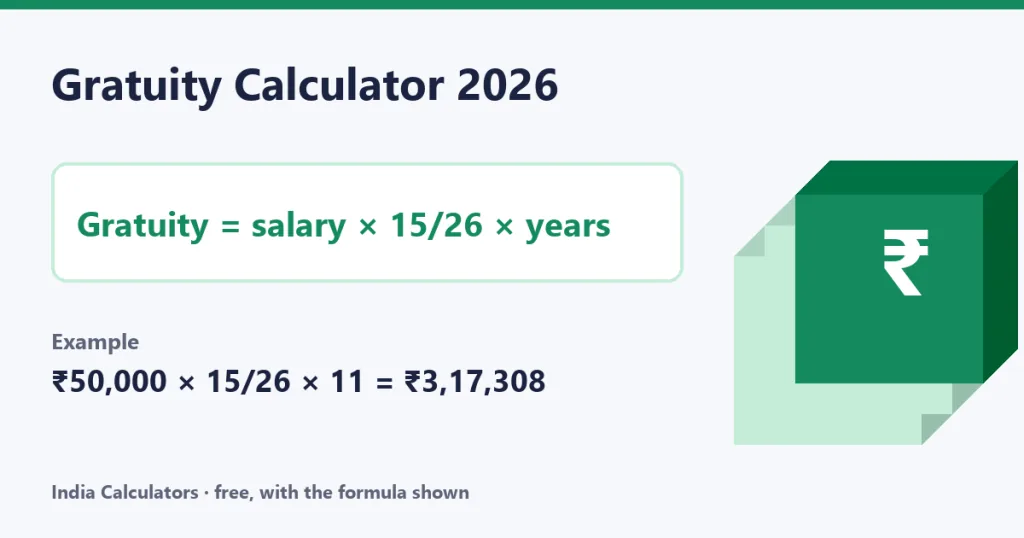
Gratuity calculator: the formula in one line
This gratuity calculator uses the Payment of Gratuity Act formula: last basic + DA × 15 ÷ 26 × years of service. Service of more than six months in the final year counts as a full year, the usual minimum is five years, and the maximum payout is ₹20 lakh.
How to use the gratuity calculator
- Enter your last drawn monthly salary: basic pay + dearness allowance (DA), not CTC.
- Enter years and extra months of continuous service.
- Choose whether your employer is covered by the Gratuity Act (most companies with 10 or more employees are) and whether you are a permanent or fixed-term employee.
Gratuity formula
Covered employers: gratuity = last salary × 15 ÷ 26 × years of service. 15 is half a month’s pay for each year, and 26 is the working days in a month. Service of more than 6 months in the last year counts as a full year.
Not covered: many employers use 15 ÷ 30 and count only completed years.
Under the Code on Social Security 2020, fixed-term employees qualify after one year, pro rata. If allowances excluded from ‘wages’ are more than half of your pay, the extra is added back to wages.
Worked example
Basic + DA of ₹50,000, service of 10 years 7 months (counts as 11): 50,000 × 15 ÷ 26 × 11 = ₹3,17,308.
Limit and tax
The maximum gratuity payable is ₹20 lakh (Labour Ministry FAQ, December 2025). Tax exemption limits are separate: check the current Income-tax rules or ask a tax adviser. Government employees follow their own service rules.
Gratuity at a glance
| Last basic + DA | 5 years | 10 years | 20 years |
|---|---|---|---|
| ₹25,000 | ₹72,115 | ₹1,44,231 | ₹2,88,462 |
| ₹50,000 | ₹1,44,231 | ₹2,88,462 | ₹5,76,923 |
| ₹1,00,000 | ₹2,88,462 | ₹5,76,923 | ₹11,53,846 |
Using 15 ÷ 26 and the ₹20 lakh cap.
Common mistakes
- Using CTC or gross salary instead of basic + DA.
- Rounding service down. Over six months in the last year counts as a full year for covered employers.
- Forgetting the ₹20 lakh limit for a large salary or long service.
When gratuity is paid and when it can be held back
- The employer must pay within 30 days of the date it becomes payable; late payment carries simple interest.
- On death or disablement the five-year condition does not apply; gratuity goes to the nominee or legal heir.
- Gratuity can be forfeited, fully or partly, only if you are dismissed for misconduct that caused loss to the employer, or for riotous conduct or an offence involving moral turpitude.
Gratuity and resignation, retirement or layoff
The formula is the same whether you resign, retire, are laid off or your contract ends, as long as you meet the service condition. What changes is only whether you are eligible: permanent employees usually need five years of continuous service, fixed-term employees one year.
How we check this page
The calculator on this page runs the same code that is covered by 41 automated tests across the site, and its rules were checked against the official sources listed below on 24 November 2026. If a rule changes or you spot a mistake, email [email protected] and we will fix and re-date the page.
Frequently asked questions
How is gratuity calculated in 2026?
Last basic + DA × 15/26 × years of service for employers covered by the Gratuity Act; more than 6 months in the last year counts as a full year. Fixed-term employees qualify after one year on a pro-rata basis under the Social Security Code.
Is gratuity calculated on basic salary or CTC?
On basic salary plus dearness allowance, not on CTC. If the excluded allowances are more than 50% of your pay, the excess is treated as wages.
How is 7 years 7 months gratuity calculated?
7 years 7 months counts as 8 years because the last part is over 6 months: salary × 15/26 × 8.
Is gratuity payable after 4.8 years?
The usual rule is 5 years of continuous service for permanent employees; some court rulings count 4 years and 240 working days. Fixed-term employees need only one year.
Is gratuity taxable?
For most private-sector employees, gratuity is tax-free up to ₹20 lakh in a lifetime; government employees' gratuity is fully exempt. Amounts above the limit are taxed as salary.
Related calculators
- In-Hand Salary Calculator: Monthly take-home pay from your CTC under the new tax regime.
- Gratuity Calculator: Gratuity on retirement or resignation with the 15/26 formula, fixed-term rules and the ₹20 lakh limit.
- Salary Hike Calculator: Your new salary and increase from a hike percentage.
- GST Calculator: Add or remove GST at 5%, 18% or 40%, with the CGST and SGST split.
- SWP Calculator: Monthly withdrawals from a mutual fund: total withdrawn and value left.