
SWP Calculator
SWP calculator: what it shows
The SWP calculator shows how long a lump sum lasts when you withdraw a fixed amount every month, how much you withdraw in total, and the value left at the end, for the return you expect. Withdraw less than the fund earns and the capital keeps growing.
How to use the SWP calculator
- Enter the amount invested.
- Enter the monthly withdrawal.
- Enter an expected yearly return and the number of years.
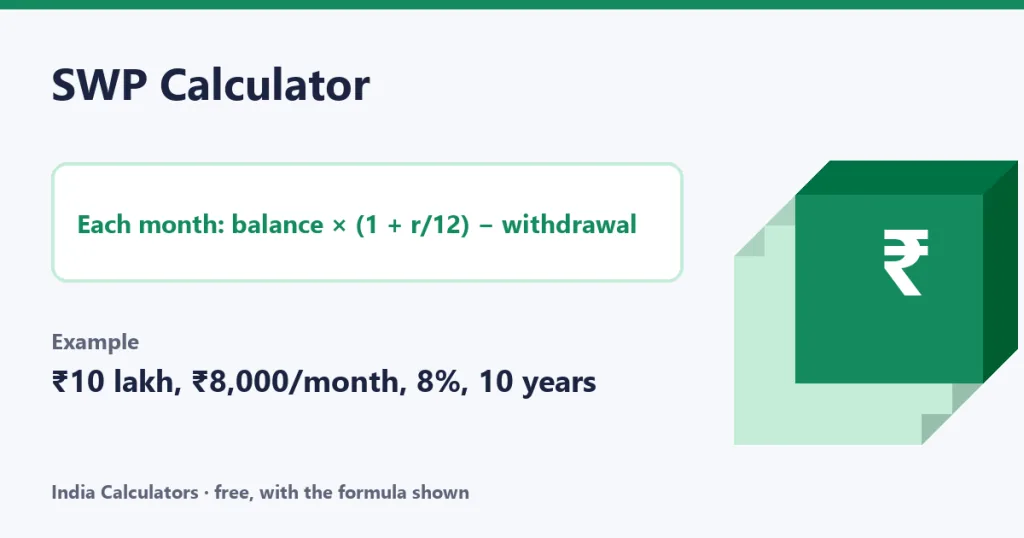
The calculator grows the balance every month and then takes out the withdrawal. If the money runs out early it tells you in which month.
Worked example
₹10 lakh at 8% a year with ₹8,000 a month for 10 years: you withdraw ₹9,60,000 and about ₹7,56,000 is still invested at the end.
Before you start an SWP
Returns are not guaranteed: markets can fall, so a lower assumed return is safer. Each withdrawal is a redemption, so capital gains tax and exit loads can apply. This is a calculator, not investment advice.
How tax works on SWP (equity funds)
Each withdrawal is treated as a sale of units. Only the gain part is taxed, not the whole withdrawal. For equity mutual funds, gains on units held over 12 months are long-term and taxed at 12.5% above ₹1.25 lakh a year; gains on units held 12 months or less are taxed at 20%. Debt fund rules are different.
Choosing a safe withdrawal
- If you withdraw less than the fund earns, the capital keeps growing.
- Withdrawing more than the return eats into the capital; the calculator shows how long it lasts.
- Returns are not fixed. Test a lower return (for example 8% instead of 12%) to see the risk.
- Check the fund’s exit load before starting withdrawals in the first year.
Common mistakes
- Treating the expected return as guaranteed.
- Ignoring tax and exit load when planning a monthly income.
How long ₹50 lakh lasts at 8% a year
| Monthly withdrawal | Result |
|---|---|
| ₹30,000 | Never runs out in 40 years; about ₹1.66 crore left |
| ₹40,000 | Lasts about 22.5 years |
| ₹50,000 | Lasts about 13.8 years |
Worked out with this calculator at a steady 8%. Real returns go up and down, which can shorten these periods.
SWP, FD interest or dividends?
| Option | Income | Tax |
|---|---|---|
| SWP from a mutual fund | You choose the amount | Only the gain part of each withdrawal |
| FD monthly interest | Fixed by the bank | Fully taxable as income |
| Dividend option | Not fixed; can stop | Fully taxable as income |
How we check this page
The calculator on this page runs the same code that is covered by 41 automated tests across the site, and its rules were checked against the official sources listed below on 24 November 2026. If a rule changes or you spot a mistake, email [email protected] and we will fix and re-date the page.
Frequently asked questions
How much SWP can I take from 10 lakh?
Withdrawing less than the fund's yearly return keeps the capital intact. At an assumed 8% return the corpus earns about ₹6,600 a month, so withdrawing up to that amount roughly preserves ₹10 lakh; more than that slowly uses it up.
What is the 4% SWP rule?
A guideline to withdraw about 4% of the starting corpus a year so the money is likely to last a long time. It is a rule of thumb, not a guarantee.
How much SWP for 60 lakh?
Use the calculator: at an assumed 8% return, ₹40,000 a month keeps the corpus at about ₹60 lakh, while larger withdrawals reduce it over time.
Is SWP better than FD interest?
An SWP from a mutual fund can give higher returns and only the gain is taxed, but returns are not guaranteed; FD interest is fixed and fully taxable.
Related calculators
- Sukanya Samriddhi Yojana Calculator: SSY maturity value after 21 years at the current 8.2% rate.
- GST Calculator: Add or remove GST at 5%, 18% or 40%, with the CGST and SGST split.
- In-Hand Salary Calculator: Monthly take-home pay from your CTC under the new tax regime.